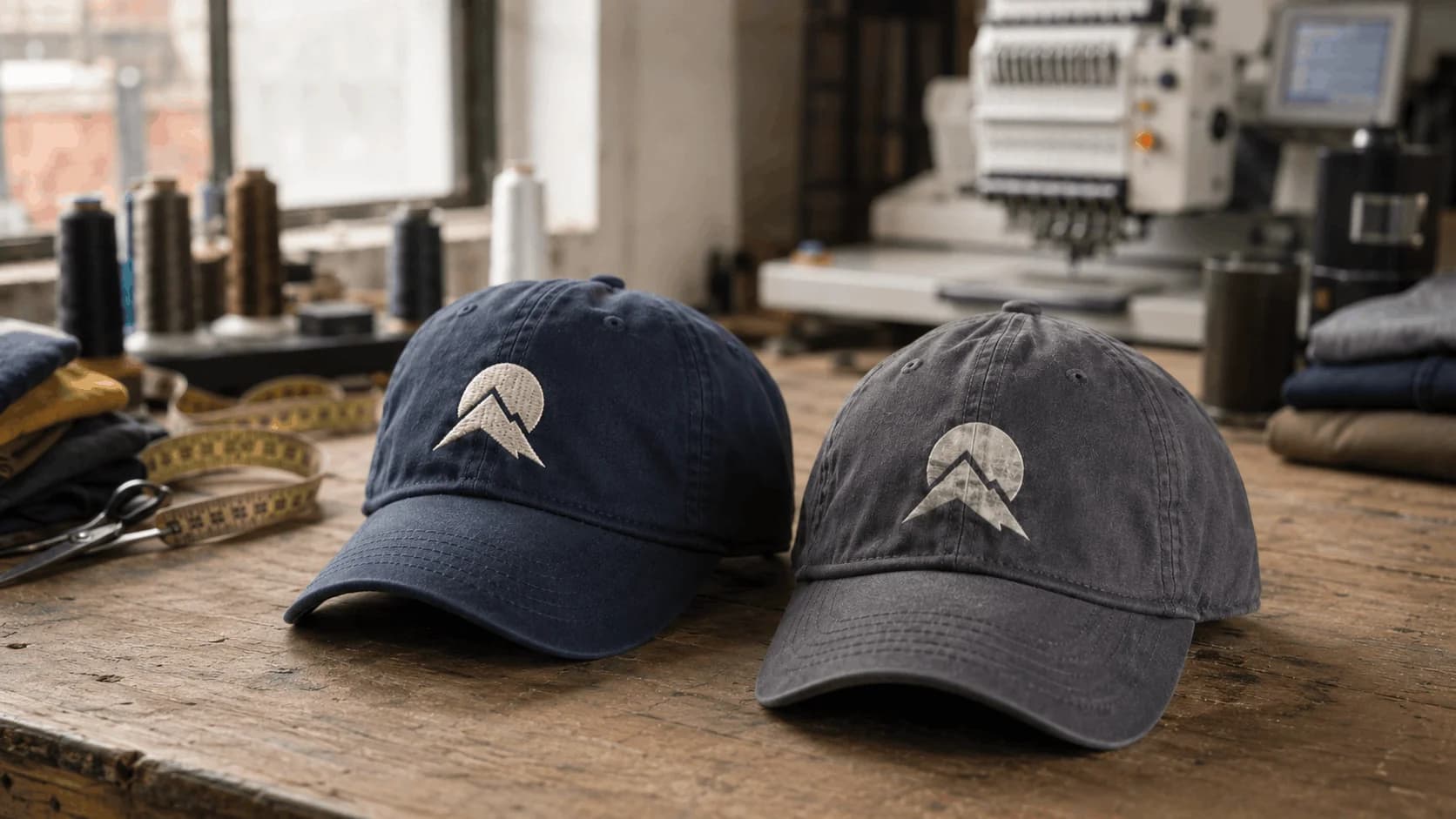
Hat Embroidery vs. Printing: Which Custom Hat Decoration Is Best?
July 31, 2026
Choosing between custom embroidered hats and printed hats involves more than deciding which finish looks better. The right method depends on your artwork, the hat’s fabric and construction, how often it will be worn, the environment in which it will be used, and the impression you want your brand to create.
Embroidery is usually the better choice for simple logos, employee uniforms, corporate apparel, and durable branded headwear. Printing is often better for gradients, detailed illustrations, multicolor graphics, promotional campaigns, and lightweight performance hats. Embroidered patches can provide a useful middle ground when you want stitched texture without applying dense embroidery directly to the hat.
This guide explains performance, cost, durability, and common ordering mistakes to help you choose between hat embroidery and printing.
Hat Embroidery vs. Printing: The Main Difference
Hat embroidery uses thread to stitch a logo, name, or design directly into the hat. The finished design has a raised, textured appearance commonly associated with professional uniforms, workwear, corporate apparel, and premium merchandise. This dimensional finish is one reason many businesses choose an embroidered hat for employee and customer-facing apparel.
Hat printing applies ink or a printed transfer to the fabric surface. Depending on the process, a printed hat can reproduce smaller details, gradients, fine outlines, distressed textures, and a wider range of colors than embroidery.
The main difference is therefore texture versus detail. Embroidery creates dimension and a traditional branded-headwear finish, while printing offers greater flexibility for complex artwork. Neither method is automatically better. The best option reproduces the design clearly and suits the selected hat.
Quick Comparison

When Hat Embroidery Is the Better Choice
Hat embroidery works especially well when a design is bold, recognizable, and intended for regular use. Company logos, short business names, employee names, initials, team marks, and simple icons usually translate well into thread.
For example, a construction company with a strong wordmark or a restaurant with a simple emblem may not need the color range available through printing. A clean embroidered version can create a more established and professional appearance.
Embroidery is also dependable for uniforms worn during service calls, deliveries, construction work, restaurant service, and other regular duties. Businesses that already order custom polos, work shirts, or company uniforms can use custom embroidered hats to create a coordinated appearance across their team.
However, large or dense stitching can stiffen the panel and reduce comfort. The logo should be readable without overwhelming the cap. A restrained embroidered mark often communicates professionalism, craftsmanship, and premium quality.
When Custom Printed Hats Make More Sense
Custom printed hats are often the stronger option when the artwork contains elements that cannot be reproduced cleanly with thread. This may include gradients, detailed mascots, fine outlines, distressed effects, photographic elements, multicolor illustrations, or complex promotional graphics.
Consider a brewery logo containing small lettering, a sunset gradient, and fine linework. Reproducing it through embroidery may require major simplification. Printing can preserve more of the original design and maintain the creative style that makes the artwork recognizable.
Modern transfer methods, including direct-to-film printing, can produce crisp, colorful graphics on compatible hat materials. Printing can also be practical for seasonal campaigns, festivals, launches, giveaways, and limited merchandise because each new graphic does not require embroidery digitization.
A printed hat may also feel lighter on performance hats, where dense thread and backing can stiffen thin panels. The fabric’s heat sensitivity, coatings, seams, stretch, texture, and curvature still require review before production.
How Artwork Affects the Decision
A logo that looks sharp on a computer screen may not reproduce the same way on a curved hat. Digital artwork can contain tiny text, shadows, gradients, narrow spacing, subtle textures, and fine internal details that become difficult to see at actual decoration size.
Before approval, view the design at its intended size. Confirm that the business name is readable, the main shapes remain recognizable, and the colors contrast with the hat.
If the mark stays clear as bold shapes and solid colors, hat embroidery may create more impact. If it depends on fine details or gradients, printing is usually safer.
The same artwork considerations apply when preparing designs for other branded products, including custom T-shirts, hoodies, polos, and promotional apparel.
Embroidery Requires Digitization
Embroidery machines do not stitch directly from a standard JPG, PNG, or PDF. The artwork for an embroidered hat must be converted into a digitized stitch file that controls stitch direction, type, density, underlay, pull compensation, trim points, and color sequence.
Good digitization helps a logo remain stable and readable on curved fabric. Fine lettering may need to be enlarged, narrow outlines may be thickened or removed, and complicated shapes may be simplified. These are normal production adjustments rather than mistakes.
Digitization is especially important for custom embroidered hats because the quality of the stitch file directly affects the final shape, readability, and appearance of the logo.
Printing Preserves More Detail
Printing can usually retain smaller lines, additional colors, gradients, and subtle effects. It still requires clean, high-resolution artwork, suitable contrast, and enough space for the design to remain readable.
Dark artwork may disappear on a dark cap, tiny text can remain unreadable, and details may distort over a center seam. Printing offers more flexibility, but it still requires thoughtful preparation.
For artwork that will be used across several products, vector files are often preferable because they can be resized without losing clarity. Adobe provides a helpful explanation of vector artwork and scalable graphics.
Hat Style and Construction Matter
The same logo can perform differently on two hats because decoration must work around seams, curved panels, crown height, fabric stretch, mesh, closures, internal structure, and surface treatments.
Structured caps have supportive front panels that suit embroidered logos and bold wordmarks. Trucker hats usually accept embroidery, patches, or compatible transfers on the solid front panel, while the mesh limits placement.
Beanies require decoration that accounts for stretch. Cuff embroidery, labels, and patches often work well.
Performance hats use lightweight or moisture-managing fabrics that dense embroidery may pull or stiffen, so a lighter transfer may be more appropriate.
The most reliable approach is to choose the hat and decoration method together rather than treating them as separate decisions.
Which Method Is More Durable?
Embroidery is known for strong durability because the thread is stitched directly into the hat. It generally handles frequent wear, outdoor work, friction, and regular cleaning well when care instructions are followed.
Loose threads may catch, bleach can affect thread color, and improper washing may distort the hat.
Printed-hat durability depends on the method, transfer quality, fabric compatibility, adhesion, cleaning, abrasion, and sun exposure. Poor material matching commonly causes peeling, cracking, or early failure.
Consider real use. Outdoor crews face sweat, dust, rain, and sunlight. Restaurant teams may need frequent cleaning. Event merchandise may prioritize appearance over years of wear.
The most durable option is the one matched to those conditions.
What Determines the Cost?
Printing is not always cheaper, and embroidery is not automatically more expensive.
Embroidery pricing is influenced by:
- Stitch count
- Design size
- Digitization
- Thread changes
- Number of decoration locations
- Hat construction
- Specialty threads
- Puff embroidery
- Quantity
- Individual personalization
A small logo may require relatively few stitches, while a large, dense design needs more machine time. Adding individual employee names also creates extra production steps.
Printed-hat pricing depends on:
- Print size
- Transfer type
- Artwork preparation
- Hat material
- Number of print locations
- Order quantity
- Personalization
A small front logo may be economical, while a large full-color design with secondary placements may cost more.
Compare long-term value as well as unit price. Expected wear, replacement frequency, comfort, readability, and washing requirements all matter. A slightly more expensive hat people regularly wear may deliver better value.
Embroidered Patches: A Useful Middle Ground
An embroidered patch is produced separately and attached to the hat. It provides stitched texture while avoiding dense embroidery directly on the main panel.
Patches work well for:
- Badge-shaped logos
- Circular marks
- Difficult fabrics
- Heritage branding
- Outdoor merchandise
- Workwear
- Trucker hats
- Retail collections
Direct embroidery feels integrated into the cap, while a patch creates a distinct badge effect.
A patch can also be useful when the design contains more detail than direct hat embroidery can comfortably support but the brand still wants a stitched appearance.
Best Method by Industry and Use
Construction companies, electricians, HVAC technicians, plumbers, and maintenance teams often benefit from direct embroidery or patches because they need durable, readable branding. Secondary information should remain discreet.
Landscaping teams may use embroidery on structured caps, while lightweight performance hats may require smaller or lighter decoration.
Restaurants and hospitality businesses often choose embroidery for uniforms and printing for promotions or colorful merchandise.
Corporate teams generally benefit from restrained embroidery. A simple embroidered hat featuring the company logo can complement custom long-sleeve shirts, polos, jackets, and other employee apparel.
For events and giveaways, printing offers flexibility for campaign artwork, while embroidery can make the hat feel like a higher-value gift.
Retail collections may use embroidery for classic designs, printing for artistic releases, and patches for workwear styling.
Common Custom Hat Ordering Mistakes
Do not assume a website logo is production-ready. Hat embroidery requires digitization, while printing needs suitable vector or high-resolution artwork. Both may require changes to size, spacing, line thickness, color, or placement.
Review the design before choosing the hat. A low-profile cap may not fit a tall logo, a center seam may cross key details, and a lightweight panel may not support dense stitching.
Avoid designs that are so large they stiffen or overwhelm the hat, as well as lettering too small to read.
Never skip the proof. For large or recurring orders, a physical sample can also reveal comfort, distortion, contrast, and readability problems that are difficult to judge on a screen.
Other common mistakes include:
- Selecting a hat before evaluating the artwork
- Using low-resolution logo files
- Placing important details over a center seam
- Choosing thread colors with poor contrast
- Making the embroidered area too large
- Assuming every fabric supports the same printing process
- Approving artwork without checking its actual decoration size
- Choosing a method based only on the lowest price
Five Questions to Help You Choose
Ask these five questions before selecting embroidery or printing:
- How complex is the artwork?
- How frequently will the hat be worn?
- What fabric and construction are being decorated?
- What should the finished product communicate?
- Is exact reproduction or dimensional texture more important?
Bold logos, frequent uniform use, structured caps, and a professional finish generally favor embroidery.
Gradients, illustrations, campaign graphics, and exact detail generally favor printing.
A patch may suit difficult materials or projects that need both texture and flexibility.
Can Embroidery and Printing Be Combined?
Yes. A hat may use an embroidered front logo with printed side text, an embroidered patch with printed internal detail, or an embroidered company mark with a printed event date.
Mixed decoration should have a clear hierarchy. Use one dominant brand element, one secondary message, and enough open space for each to remain readable.
Combining methods can increase cost and production complexity, and more decoration does not always create more impact.
A simple, well-positioned logo often creates a stronger result than filling every available area.
Final Verdict: Is Embroidery or Printing Better for Hats?
Custom embroidered hats are generally the better choice for simple logos, employee uniforms, professional corporate apparel, premium merchandise, and hats intended for frequent use.
An embroidered hat provides a durable, dimensional finish that can help business branding look more established and professional.
Printing is usually better for gradients, detailed illustrations, multicolor artwork, seasonal promotions, events, and designs that should not be simplified.
Patches work well for badge-style logos, challenging fabrics, and distinctive outdoor or workwear branding.
Before ordering, evaluate the artwork, hat construction, fabric, decoration size, working conditions, quantity, and expected lifespan. The best method makes the logo, hat, and intended use work together.
Create Custom Hats That Fit Your Brand
A strong custom hat should make your design easy to recognize, feel comfortable during real use, and support the image your business wants to present.
Print Oracle can help you compare embroidery, printing, and patch options before production. Our team will review your artwork, preferred hat style, intended use, and order requirements to recommend a suitable decoration method.
Request a quote and artwork review from Print Oracle for custom embroidered hats, custom printed hats, employee uniforms, corporate apparel, promotional campaigns, merchandise collections, or bulk orders.
You can also explore our custom T-shirts, hoodies, polos, and tank tops to create a coordinated branded-apparel collection.
Frequently Asked Questions
Is Embroidery or Printing Better for Custom Hats?
Embroidery is usually better for simple logos, uniforms, premium branding, and frequent wear. Printing is often better for detailed, multicolor artwork and gradients. The right choice depends on the design, hat material, use, and budget.
Does Embroidery Last Longer Than Printing on Hats?
Embroidery is known for strong durability because thread is stitched into the hat. Printing can also perform well when the correct process is applied to a compatible fabric and proper care instructions are followed.
Can a Detailed Logo Be Embroidered?
Some detailed logos can be embroidered after small lettering, thin lines, gradients, and complex shapes are simplified. Printing, a woven patch, or a printed patch may be better when exact detail must be preserved.
Are Custom Printed Hats Cheaper?
Not always. Printing costs vary by size, transfer type, material, artwork, quantity, and placement. Embroidery costs depend on stitch count, digitization, locations, thread changes, and personalization.
What Hats Are Best for Embroidery?
Structured baseball caps, trucker hats with solid front panels, many snapbacks, and cuffed beanies often work well. Fabric weight, seams, stretch, crown height, and design density still need to be reviewed.Structured baseball caps, trucker hats with solid front panels, many snapbacks, and cuffed beanies often work well. Fabric weight, seams, stretch, crown height, and design density still need to be reviewed.
Can DTF Printing Be Used on Hats?
DTF printing can work on compatible hat materials and panel styles. The fabric must tolerate the application process, and seams, coatings, curvature, stretch, and heat sensitivity must be considered.
Are Patches Better Than Direct Embroidery?
Direct embroidery creates an integrated appearance, while patches produce a distinct badge-style finish. Patches may work better for difficult fabrics, detailed emblems, or brands that want a consistent design across several hat styles.